Thursday, July 7, 2011
Third Year Update
I moved to Ouaga at the end of January, after a month long vacation in America. For those who don’t know, Ouaga(dougou) is the capital of Burkina Faso. The city is about as Western as Burkina can get. Situated smack dab in the middle of the country, it boasts a population of 1.5 million people, and has pretty much anything you could possibly want (if you know where to look). I don’t like taking my camera out around the city but I’m sure if you Google image search Ouagadougou, you will get a better idea of what it looks like. It’s actually quite large, as it takes me at least 45 minutes and a change of taxis to get from one end of the city (i.e., my house) to the other (i.e., Peace Corps office). Luckily taxis, green and usually dilapidated, are fairly plentiful, and most days it isn’t hard to snag one heading in your direction. Downtown, there are lots of great restaurants and cafes, which I try to avoid as much as possible to save money, though I have been known to splurge from time to time. There are also a couple fairly decent supermarkets downtown, which have lots of the luxuries of the West (I’m thinking cheese, meat, wine, etc), but I try not to break the bank there either. Other places around town to spend money at include Eurotex, the large textile warehouse (think Project Runway) to buy fabric to have clothes made, as well as several home stores like Orca, an amazing four-story building that’s the closest thing to a Bed, Bath, and Beyond that this country has.
If you head southwest of the city center and just keep going, after twenty minutes or so, you will hit my neighborhood, a slice of Sector 17 known as Kouritenga. It is here on the edge of town where I live and work. My humble abode is pretty amazing for Burkina (and Peace Corps) standards. I have a private courtyard, which just means my house is completely walled in and has a large metal door at its entrance. Most homes are gated in the city, for safety and privacy, I suppose. Upon entering my house, you see a fairly spacious living room (20’ x 10’) which I have furnished as best as possible on my limited means with a bookshelf, a coffee table, a “couch,” and a few end tables and a chair. By “couch,” I am actually referring to something that more resembles a wooden park bench with cushions on it. Beyond the living room is a smaller-sized kitchen with a double sink and a good-sized countertop. I have added to it a gas stovetop, a small refrigerator, and a few cabinets for dishes and glasses. Off the living room are two bedrooms, each with its own bathroom. I have made the bedroom closest to the front of the house the master bedroom since the bathroom is a wee bit larger, and I use the other bedroom for storage. In addition to the living room furniture, I had a carpenter build a full-sized bed and two bedside tables, and I bought a build-it-yourself armoire from some vendor on the street. My bathroom has a shower (no hot water), a sink, and a real flushing toilet (good riddance, hole in the ground!). Let’s just hope everything stays in working order. My entire house has white tile floors, which makes regular mopping necessary yet easy. I have hired a young woman named Balguissa to come to my house twice a week, once to mop and tidy up and another time to wash my laundry. I pay her 8,000cfa (roughly $16) a month, and she does a fairly decent job at it, especially considering the wrecking ball of a creature that is my kitten. Every morning she (who I have dubbed Lady Waga) has serious fits of friskiness which can only be expressed by tearing up my house and clawing on my curtains. To say she is spoiled is an understatement. Living with a cat has certainly taught me one thing – I am definitely a dog person.
If you leave my house, and walk a block south, you will hit the association with which I am working this year. Yes, I am still a Peace Corps volunteer (as seen by my paychecks), but my primary responsibilities are now concentrated on a local NGO. This organization is called Association Trait d’Union des Jeunes Burkinabe. It really has no good English translation, since trait d’union means hyphen in English, and no one is able to really explain why it’s called that. From here on out, I will call it, as everyone calls, ATUJB (in French, it comes out sounding like “ah-to-ji-bay,” God bless you). At its heart, ATUJB is a youth organization that focuses primarily with kids and young adults who are at risk of HIV/AIDS. While this encompasses many individuals, most fall into one of three categories: street children (enfants de la rue), street vendors (vendeurs/vendeuses ambulants), and sex workers (travailleuses de sexe). Our association, which we often refer to as “the center,” is comprised of a large gazebo in the middle of a courtyard, surrounded by buildings on all four sides. On one side, there is a row of offices where most of us usually work. On another side, there are two large dorm rooms where about two dozen street children sleep every night. The remaining sides house various workshops, where underprivileged young people take apprenticeships in tailoring, motorcycle repair, carpentry, metal work, traditional crafts, etc. The goal of the center is to give kids without homes (or healthy homes), who are at risk of HIV transmission, a place to stay and to provide them the opportunity to go to school and learn a trade so that with time, they will be able to reintegrate into society with the skills necessary to succeed.
The ATUJB team consists of close to 20 full-time employees, some of whom I work with everyday and some of whom I never do. For instance, we are one of 42 associations in Burkina that provides free, confidential, and anonymous HIV testing to anyone who comes in. There are a few individuals who are in charge of testing, but since I work mostly on the prevention side of the fight, I hardly ever work directly with them. Others are in charge of the education programs for the children at the center, which I am not. I would say the team I work most closely with usually consists of about seven individuals, including the president and vice-president of our organization. Our president just got back from a trip to New York City to attend the World HIV/AIDS Summit that happened a few weeks ago, so we are clearly a force of an organization. Both he and our vice-president, a giant of a man, are incredibly nice to work with.
My position at ATUJB is as Technical Support Specialist for its HIV/AIDS program, which sounds more impressive than it is, I’m sure. Basically, I’m involved in two main projects. The first is a UNICEF-funded, two-year long project of HIV awareness activities using peer educators in five different cities throughout the country focusing on high-risk socio-professional groups. We held a training about a month ago entitled “HIV Risk Mapping,” c’est-a-dire, identifying the localities in an area where the risk for HIV transmission is elevated due to a higher concentration of high-risk individuals. The second project is an ongoing PAMAC-funded activity that involves educating prostitutes here in Ouaga on HIV and other STIs. As in any big city, prostitution is a real problem, and the latest information suggests that about 14% of sex workers here are HIV-positive, which means about one in seven are infected. Burkina has been lucky that HIV hasn’t hit the general population as it has in East and Southern Africa, but prevention activities are still paramount to blocking a pandemic in this country. Therefore, ATUJB works with prostitutes to raise awareness of HIV/AIDS, other STIs, the importance of condoms (male and female), how to properly use a condom, how to negotiate condom usage with clients, and basically anything related to their sexual health. We also partner with local clinics to provide free health screenings (including STI exams) and distribute as many condoms and sachets of personal lubricant as possible. For the past few days, I’ve been working on brainstorming new strategies of intervention. Since recently many of the brothels in Ouaga have been shut down, unfortunately many woman now simply take to the streets, so where we could have simply planned health talks at the brothels before, now we have to figure out how to reach these women who no longer have a fixed location. It is actually a fairly complicated situation, and one that requires a new strategy on our part. Other activities I had assisted with include interviews with Nigerian sex workers, surveys with area bars and nightclubs on their clientele, and follow-up and evaluation on various HIV trainings in different cities. I also act as a liaison between ATUJB and UNICEF (who actually interviewed and hired me), documenting for them our association’s activities that they fund.
All in all, I am enjoying my final year in Burkina. There have been ups and downs as with any experience, but hopefully when I look back at 2011, I will be content with my decision to stay. It has not been without challenges. Not to go too deep into detail, but beginning in February, Burkina Faso began experiencing political protests that resulted in military mutiny, a coup, and a complete restructuring of the country’s government. If you want to know more, I’m sure Google would be able to help you out once more. But basically, this means that from February until May or so, the country was under various national curfews and saw destructive protests by everyone from the military, students, and merchants. And since Peace Corps’s number one duty is to protect its volunteers, my life was made complicated for several months as PC placed its own curfews and restrictions on us, which made a daily routine rather difficult, especially here in Ouaga, the epicenter of it all. Also all of our activities at work were for all intents and purposes blocked by sponsors who insisted on waiting out the situation before making the funds available to us. But now things have seemed to calm down considerably, enough to dive into work without wondering when the next protest will happen. And as the political climate gradually cools down in Burkina, so too is the actual temperature, which makes me especially happy. It seemed as though this year’s hot season was much more intense than the previous year and lasted longer. It is still fairly hot, but a few weeks ago, the rains finally began. Now we are averaging perhaps a good rain every three days or so, which often comes with a nice chill in the air. Hopefully in the weeks to come, we will see it raining every other day. Although the rain brings mosquitoes and mud, the benefit of not sweating all the time greatly outweighs any downside. I am excited to finally say I’ve survived my last hot season in Burkina and look forward to more temperate temperatures until the conclusion of my service.
And that about sums up my experience so far this year. We are already at the halfway mark, and I can feel the sands in the hourglass falling swiftly. It won’t be long before I am planning my returning to the States (with a possible side trip along the way), so I need to remind myself to take everything in that I possibly can, to suck the marrow out of every experience left here.
(Let it be known that my internet connection is through a usb key that runs off of the cell phone network, so uploading photos will be very difficult, but if I get the change to have a faster connection, I’ll try sticking up a few photos too)
Saturday, December 4, 2010
A Change Is Gonna Come
It’s been two years since I came to Burkina Faso. I have learned a lot and have experienced so much – good and bad – during this time. I have but one more week left in my village, one week to say goodbye, to pack up and leave. As the sands in the hourglass continue to fall, I am feeling good about this transition. I have given a lot to this community and they have given me just as much back, but I am ready to step aside and pass the torch to another volunteer. When I leave, a newly sworn-in volunteer will replace me at my site, bringing another point of view and another skill set to offer, which I think is beneficial to everyone.
Still, it will be very difficult to say goodbye. There are many people in my village – friends, colleagues, and neighbors – that I will honestly miss. As I start telling people I am leaving, the overwhelming reaction is the same: Don’t go. No matter how I explain it, people want me stay here, which warms my heart and makes these conversations all the more difficult. Of course, I know they will embrace the new volunteer just the same.
So what’s the next chapter in this story? Usually, once you serve your two years in Peace Corps, your contract is finished and they send you home for good. Well, my situation is a bit different. I have yet to mention it before as everything was still iffy, but it looks like I will be staying in Burkina Faso one more year. Yep, you heard right. I have extended my contract until January 2012. So what do this mean? I will still be heading home in about two weeks but for one-month vacation, not for good. In mid-January, I will return to Burkina to start my new job in Ouagadougou, the capital, the big city. I will still be considered a Peace Corps Volunteer and still receive my living stipend from PC but I will be working in a partnership with UNICEF and a local NGO called Association Trait d’Union des Jeunes Burkinabe (ATUJB), an organization focused on HIV/AIDS prevention among at-risk youth and sex workers in Ouaga. I will work with ATUJB for a one-year contract, helping to develop prevention activities, to perform qualitative studies on various risk factors, and to creatively document the work of the NGO. All the while, I will be living in a house provided by them in Ouaga.
I have known for several months that I wanted to stay for a third year, but didn’t want to stay anything until I knew for sure. It was a long, long process of applications, interviews, and waiting, but I am happy to say it is finally official. I am really excited to start my new job next year. As someone who is often afraid of change, it feels right. I will be using the skills I have acquired these past two years, technical and language, in a new environment. It will give me a chance to explore development work as a possible career path and keep me from having a panic attack looking for a job in America (at least for one more year). It should also be a nice transition back into American life, as I will be living and working in a large city atmosphere, much, much different from my life in Aorema. All in all, I am very content with how things have worked out and am looking forward to next year. There are also about half a dozen others from my training group who have also decided to stay another year, throughout the country, so I am not alone.
As for this blog, I am not sure what will happen. I know I have slowed down posting this year, but I would consider continuing if people are still interested. So let me know if you want to hear from me next year. Peace.
Saturday, September 11, 2010
Ça Fait Deux Jours
With that said, let's try to do some major catching up.
1) Benin & Togo Vacation: I had an amazing 16-day trip down through Benin and then up through Togo. We had some great days on the beach, some really cool hiking experiences, several trips to amazing supermarkets, and enough funny (and often awkward) moments to last for years. If I ever get motivated enough, I'll try to type up a more detailed trip report, but until that moment arrives, enjoy these few vacation snapshots:

On one of our hikes in the mountains, our guide showed us how to find traditional paints from different plants, like the yellow pigment under the bark of this tree.

3) Since coming back to village, things have been slow. Its rainy season still, so people are out in the fields working most days, which makes it feel like a ghost town most of the time. I have taken advantage of this and gone into the fields to help, which always gets the funniest looks from everyone around, but you can tell people are really impressed that I am actually out there at all.
Yesterday, we partied hard as Ramadan, the month when devote Muslims fast from sunrise till sunset came to an end. On this final day, known to Muslims around the world as Eid al-Fitr, everyone congregated to the center of the village for a huge prayer at 9am. Even though I am not Muslim, I really enjoy going to these kinds of events, if not solely for the integration aspect; everyone in the village goes and it is a great social gathering. After prayer ends, the rest of the day is spent relaxing and eating 5and eating and eating). You basically go from one house to the next, wishing people a bonne fete, and you are expected to sit down each time and eat. This can get pretty crazy after you have stopped by four or five friends' houses. I went to see my good friend Ynoussa, who gave me a huge bag full of raw beef to cook up for myself later, and then he took me to say hello to the vieux, a respected old man in their family compound who then fed me macaroni and liver (yum!). I then went and ate with another friend Haoua and then with my major. I had bought a bottle of sparkling wine that my major, my friend Ynoussa, and I shared as well (Ynoussa, although the only Muslim in the trio, is not so strict a Muslim as to pass up a free drink). All in all, it was a really nice celebration, despite eating way too much. Hope everyone else had a wonderful Ramadan!
Friday, June 11, 2010
Benin and Togo!
Sunday, May 23, 2010
Noewadi?
If you remember, last month I was planning a three-day regional conference on Maternal and Child Health for six volunteers and 12 counterparts in local language. While the planning was arduous at times, I believe it was worth it. On the first day, we discussed malnutrition – its kinds, causes, and consequences – and learned how to identify malnourished children, allowing our participants the opportunity to use baby scales, arm measurement bands, and charts that follow a child’s age, height, and weight. We also learned about the preventative behaviors against malnutrition, including proper nutrition, hygiene, and breastfeeding practices. At the end of the day, we took a field trip to our local CREN (Centre de Réhabilitation et d’Education Nutritionnelle), where severely malnourished children are referred for hospitalization and rehabilitation. We were given a quick tour of the facility and afterwards had a Q&A with the nurses and mothers about their own experiences. On the second day, we dove into the FARN (Foyer d’Apprentissage et de Réhabilitation Nutritionnelle), the 12-day activity that I performed with a group of mothers and children in my village, where we make an enriched porridge from local ingredients and discuss a different health topic each day. After describing the basics of the program in the conference room, we headed outside to practice cooking different kinds of enriched porridge. Later on, those of us who had already performed the FARN described our experiences – our struggles, our successes, and our suggestions. On the last day, we headed back to the CREN, and the participants, separated into three groups of four, presented to the mothers present a health topic that they had planned the day before. It was quite useful for the counterparts to experience talking in front of a group, and I think most really enjoyed it. Afterwards, we wound the conference down, briefly hitting upon follow-up steps for the FARN, working side-by-side with NGOs in village, and several other maternal health issues not yet covered. We closed with a slideshow of all the photos taken during the conference. All in all, I really see this as a successful undertaking, as both the volunteers and the counterparts took a lot away from it. I know that many, upon their return, have already started or have planned nutrition activities in their own villages.
Unfortunately, I have had little time in village lately to get any large projects off the ground. I went to Ouaga earlier this month for a meeting with an NGO, and I will be going back to the capital on Sunday for three days of training for PSDN (Peer Support and Diversity Network), a PC committee I’ve joined, whose charge it is to empower fellow volunteers by supporting their emotional needs and providing an ear to discuss issues in a nonjudgmental and confidential manner. The week after that, I will be in Ouahigouya for a week of training to be a facilitator for the incoming group of new trainees, who arrive in June. We will be having the largest group of newbies that PC Burkina, I believe, has ever seen at one time – over 75 in total (more than double my group). Everyone is really excited for their arrival but you can imagine how crazy logistics are for so many people. If that were not enough, there will be another group of thirty or so that will arrive in October. Basically, training will be going on for the remainder of my service.
At least I have finally been able to begin Fulfuldé lessons, as I have wanted to do for some time now. To refresh your memory, French is the national language of Burkina and the language I use most often when working or in bigger towns and cities. Mooré is the language of the Mossi, the largest ethnic group and the people that dominate my region; I use Mooré when speaking to people in my village, playing with the children, and shopping in the market. The next most predominant language spoken around me is Fulfuldé, spoken by the Peuhl community. My health clinic services one Peuhl village (called Lembnogo Peuhl, actually), as well as a small cluster of huts on the outskirts of my own village (called Bouna Peuhl). The Peuhls, to the best of my understanding, are mostly a herding community (as opposed to the agrarian Mossi), with a culture and language very distinct from the Mossi majority. Aesthetically, the Peuhls have much more Middle Eastern features with tall, slender bodies, thin noses, large ears, and lighter skin. People often joke that Barack Obama is a Peuhl, and I can absolutely see their point. Linguistically, their voices are usually much higher in pitch, and to be honest the women often sound something like Minnie Mouse. Unfortunately, I have heard and seen firsthand discrimination between the ethnic groups, and the Peuhls are often overlooked or disregarded when it comes to healthcare services. As my market is also one of the larger cattle markets in the area, there are always Peuhls everywhere, and I have always felt, if not shame, then perhaps guilt that I cannot even greet someone in Fulfuldé.
To give you an idea of what Fulfuldé is like, here’s a short list of things I learned from my first lesson (of course, the spelling is all my own)*:
Good Morning: Djamwaali
Response: Afinyedjam
Second Response: Basifuwaalai or Djamni
Good Afternoon: Awetidjam (to 1 person) or Onwetidjam (to 2+ people)
Response: Noewetirrda (to 1 person) or Noewetirrdon (to 2+ people)
Second Response: Basifuwetai or Djamni
Good Evening: Djamnyali (to 1 person) or Djamnyalodon (to 2+ people)
Response: Noenyalirrda (to 1 person) or Noenyalirrdon (to 2+ people)
Second Response: Basifunyalai or Djamni
Good Night: Ahiridjam (to 1 person) or Onhiridjam (to 2+ people)
Response: Noehirrduda (to 1 person) or Noehirrdudon (to 2+ people)
Second Response: Basifuhirai or Djamni
How’s it going?: Noewadi?
Response: Wala
What’s your name?: Noewieteda? or Noewuni indema?
My name is Erik: Erik wietemi. or Erik wuni inde am.
What do you want?: Dome hadyada?
I want food: Mihadya nyamde.
What do you do (work)?: Dome gollata?
I work at the health clinic: Doctorore gollanmi.
Where are you from?: Tue yurata?
I’m from America: Amerik yuranmi.
I live in Aorema: Aorema wudom.
*The “d”s that I have bolded are not actually pronounced like a “d”, but it’s the closest and easiest approximation. They are more a mix of “d” and “th” produced in the back of the throat. Also, the “rr” is meant to be rolled similar to the Spanish way but further back in the mouth. No an easy language.
BFBFFs, Burkina Faso Best Friends Forever
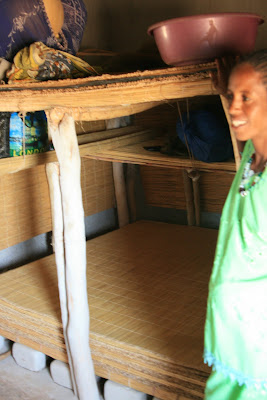
One woman invited me into her home to "see how the Peulhs live." Her bed here looked really comfortable actually.
Saturday, April 24, 2010
I Spy With My Little Eye Something . . . Orange
Unfortunately, I feel like I have not done many activities in village lately like I would have liked to do aside from my regular soap-making with the women, but I am certain once this is over, I will be able to direct my concentration back on my own projects. At least I can say I’ve survived my second April in Burkina with only a couple sweaty t-shirts as battle scars of hot season (which is more than I can say of my poor papaya tree). I would guess that I’ve drinking about 4-5 liters of water on average everyday, even more on those scorching 120° days and haven’t lit my stove save once or twice in the past three weeks. I’ve avoided the stove (which raises the temperature in my house a good 5-10 degrees) by changing my diet to that of a woodland creature. A lot of raw veggies or vegetable sandwiches – cucumbers, tomatoes, and green peppers make a great sandwich – plus as many mangoes as I can manage. I try to eat a bag of peanuts each day for the protein but every once in a while, I’ll supplement that with tuna or chicken packets from home. Every market day, I also buy something known as acheke (pronounced a-check-ay or a-keck-ay) which is made from cassava root, with a small piece of fish for lunch.
Below are the accompanying photos:
Monday, April 5, 2010
April Shmapril
But as life always brings the good with the bad, cushions the difficult with the easy, the hot season here also corresponds to our mango season. Yin meet Yang. Yang, Yin. The country is becoming inundated with these juicy, sweet fruits, and they make the heat slightly less unbearable each year. There are dozens of varieties of mangoes in Burkina, maybe more, and each brings something different to the table. Large or small, stringy or buttery, the subtleties in taste and texture make mango season a good time to be alive. Everyone has their favorite kind and their preferred method of eating. Some people eat the skins and all, others use a knife to cut the meat into cubes. I tend to peel back the skin with my teeth and then dive right in. My plan is start drying a lot soon, so that I can keep the mango goodness well past the end of the season (that is, if I can keep myself from eating them right away).
Last weekend, almost every volunteer (more than 100) showed up in Ouaga for the COS party, our ritual celebration honoring those volunteers who have reached their Closure of Service and are getting ready to head home beginning in June. It was a lot of fun to see all my friends living in other parts of the country with whom I rarely get to hang out. It is weird to think that another group is preparing to leave. Once they have departed, my group will become the new senior volunteers. For logistical reasons, our group's COS conference and party will actually take place in July, much much earlier than normal. It is far too early to consider the end of the road here in Burkina and the prospect of rejoining American society.
In work-related news, not much has changed in village. I am still actively working with the soap group I helped organize (they have made almost 20,000 cfa in a month and a half, i.e. a lot of fric), and I may expand to form a new group in a satellite village. I have also been asked to help coordinate a regional conference on maternal and child health for several volunteers and their village counterparts that will take place in Ouahigouya at the end of the month, so I've been fairly occupied planning the logistics. There's a lot of work still to be done but hopefully the effort put into it will show during the workshop.
Well, that basically sums up everything that's going on right now and my current place in this crazy world, taking life one day, one degree, one mango at a time.
Saturday, February 27, 2010
Hi-Ho, Hi-Ho
On the first day, the women whip a product called tansagex in a large basin for 10 minutes. The tansagex is sold by the kilo in the capital. It is basically concentrated soap that resembles shaving cream or marshmallow fluff after a good beating.
After 10 minutes, the women add salt water to the tansagex to make it soluable, followed by small amounts of alternating fresh and salt water to make about 15 total liters of foam.

They let the basin sit over night to allow the foam to dissipate, and the following day we meet back to add perfume and coloring. We then fill up recycled plastic soda bottles with our awesome soap and sell them in the community for 125 cfa each (roughly $0.25). We usually make about 35 bottles per batch but this time we doubled up and made 65 bottles! We then break for a couple days before we meet back to collect money from everybody. All in all, they are very proud of their new business and the money they've made.
Besides helping start a soap group, I have also been incredibly busy planning and finally executing what we in Peace Corps call a Hearth project (in French it is known as a FARN, or Foyer d'Apprentissage et de Réhabilitation Nutritionnelle). This is an activity for mothers with moderately malnourrished children to help rehabilitate them through 12 days of making enriched porridge together and discussing various health topics each day. It requires a lot of planning - finding the children, convincing the mothers, setting dates, getting counterparts to help, gathering materials. I have been trying to figure this out for months. Finally, we set the dates (February 15-26), found 11 mothers to participate with their children, and got the support of all three of the nurses at the health center. We divided the 12 days so that each nurse would help me for four days each. Throughout the activity, we discussed a range of topics which included, basic hygiene, diarrhea and dehydration, nutrition, vaccinations, family planning, malaria, HIV/AIDS, and meningitis. The women were clearly really appreciative of all that they had learned throughout the program. Despite several small hiccups, which is expected for the first time of this quite complicated activity, and that fact that I am still completely drained of all energy, I think it was a good experience for everyone involved. Most of the babies gained about 0.2 - 0.4kg (though one baby gained almost a full kilo) during the 12 days. It sounds like a small increase but most of these babies had not gained (or even had lost weight) in the past few months, and the real results will not be fully understood until after a month or two when we do follow-up weighings with these children. That is when we will better know if the women have kept up what we taught them during the activity. If I do decide to do another Hearth, I think it would go much smoother now that I've already done one, but all I know is that I need to recover from this last one before I think about a sequel.

Monday, January 25, 2010
To America and Back
It was really weird to be home at first. I can’t really describe the feeling but the word “surreal” comes to mind. So many cars. Everyone speaking English. Nobody staring at me like a celebrity. So many fat white people. Within a couple days of being home, we had a big snowstorm, leaving us with well over a foot of snow. They said it hadn’t snowed like this in Virginia in December since, oh, about 1918. Another Christmas miracle. It seemed like the days before Christmas went by much slower than those after. Perhaps it is because at first I mostly relaxed at home, caught up on TV shows I had missed, and didn’t do much. But after Christmas I hung out more with friends, ran errands, and checked things off my to-do list, basically sucking the marrow out of America, as it were. I drove to Williamsburg (my college town) one day to hang out with a friend there, and another one of my friends drove up from NC to bring in the new year with me and hang out with the family for a few days. Very cool. I also saw lots of movies with my family while I was home, including Invictus, Me and Orson Wells, The Young Victoria, Avatar, Sherlock Holmes, and I know I’m missing one. I would also describe all the food I ate, but I think that would only serve to hunger and sadden me, so I will just say I ate really, really good food and a lot of it.
The snow was almost completely melted when we drove back to Dulles on January 6. I was just getting used to American life again when it was time to say goodbye. I took back two bags full of food and a head full of great memories (thanks again, guys). The plane rides back to Burkina were as uneventful as the first ones, except running into a fellow volunteer in Paris on her way back as well. We split the cost of taxi back to the Peace Corps house in Ouaga and even lucked into snagging the last two beds in the house for the night without making reservations. Another Christmas miracle, right? Since then, I have been trying to readjust to Burkina life again, and resettling into village for my second year here. I have a malnutrition program loosely planned for the start of February, along with a few other smaller activities scheduled for the coming weeks. Crossing my fingers that I can get into a work grove soon to keep me busy. Until next time.
Tuesday, December 15, 2009
Independence Day (Burkina Style)
Peace Corps was invited to join the parade, so a dozen volunteers from the surrounding area, myself included, accepted the call to march. Of course, this isn't your typical American parade that includes large balloons of cartoon characters and ends with Santa, so of course the marching is not taken lightly. I would not go as far as calling it goose-stepping, but it is definitely highly militaristic, which means everyone has to practice. The soldiers had been practicing for several weeks, but for us civilians, we all came into town on Monday to rehearse. Like all things in this country, practice consisted of waiting for several hours in the heat, followed by twenty minutes of actual marching. I biked back to village afterwards, as I had baby weighing and other activities to deal with in Aorema. I returned to town Thursday the 10th, as we were required to be in our places to march at 6am on Friday. Thursday turned out to be interesting as well with more than a dozen parachuters falling from the sky, a sight that caused all men, women and children to take off running towards their landing spot.
So we roll over to our position Friday morning a little after six in our awesomely amazing (and not at all frumpy) lime green uniforms. And then we wait. And wait. And wait a little more. It isn't until about 9:30am when the President, a man named Blaise Compaore, shows up. He does a quick drive-by, waving to all the different groups who are going to march. When he saw all of us, the only whities in the parade, he gave us a big smile, which was kind of cool. Then we waited about another hour for the parade to actually begin. All in all, it was pretty tiring but a really cool experience to march in front of the President, the thousands of people watching in person, and the hundreds of thousands watching on TV (as standard television in Burkina has only one channel). I hope we made Peace Corps and America proud. Afterwards, a few PC staff members, including our Country Director, took us all out for lunch, which was really nice on their part. As I wrap this up, I should remind you that this is the last blog post I will write until I get to America. My flight leaves tomorrow (Wednesday) night and if all goes well, I will be on US soil Thursday afternoon. See you next year, Burkina!
Until then, enjoy the following photos, courtesy of fellow volunteer Rob Hartwig, who came to support his fellow PCVs:
Our group photo, during the three-hour waiting period before the parade began
Sunday, November 22, 2009
Trip Report: Mali
Exactly two weeks ago (a Monday), our quartet met in Ouahigouya, my regional capital and the town where I am currently typing this up. Our group consisted of myself and three fellow volunteers from my training group: Sara, Audrey, and Ilana. Ilana and I greeted the other pair at the bus station here in the evening and then grabbed some burgers at a restaurant in town. After dinner, we split up. Ilana and Sara went to stay in Ilana's village only a few kilometers away and Audrey and I stayed with a fellow volunteer in town.
TUESDAY: We met up again the following morning at around 7am near the bush taxi station. We were quickly greeted by a man in a black cape with a scarlet lining. You know your trip is going to be great when the first person you meet is a man in a cape. He showed us to our mode of transport, an old van that had seen better days. We bought our tickets to Koro, a large town just across the Mali border and found spots on a bench. We sat, eating our breakfast of chocolate croissants and chatting amongst ourselves for maybe two hours or so until the car was full. We then piled inside, about 16 of us, only to wait another hour or so. It was amusing to find out that more people on our ride spoke English than not, as we were in the company of two Nigerians, two German girls, and a man from the Netherlands, which put the anglophone tally at 9 people. We finally left Ouahigouya at around 10:30am, only to have our bush taxi get a flat tire not even three kilometers into the trip. After another 15 minutes or so, we finally started moving, albeit at a snail's pace. As we neared the border we began to make several arbitrary stops, five in total, which ate into our day. We first stopped at a Burkina police station to have our passports looked at, and then we stopped at the Burkina border control to receive our exit stamps. We stopped again at the border to buy our visas, then another time to have our passports looked at again on the Mali side, and finallly a last stop, apparently so a Malian policeman could purchase a bag of dried coconut from a lady in our van. During these stops we took the opportunity to get to know the other whities who were traveling with us. We ended up invited the two girls from Germany to join our party as they really didn't seem to have much of a plan. We finally arrived in Koro, where we met our trusty leader Oumar, a one-of-a-kind guide. It is impossible to fully appreciate Oumar simply by describing him. He is a 31 year old, Dogon-born man whose English has been ¨perfected¨ by twelve years of constant Peace Corps groups coming through. He said 95% of all his clients are PCVs, so you can imagine how colorful his language is. He could have been pulled right from the movie screen, a fusion of Borat and the Crocodile Hunter. As he is used to American ¨troublemakers,¨ he has no problem answering your pointless inquiries with ¨That's a stupid question, shut up.¨ He also has the tendancy to curse like a sailor constantly, always asking things like: ¨Where's the f***ing food? I'm f***ing hungry.¨ I digress. So we met Oumar in Koro and he took us to a restaurant for lunch, where he showed us a map and described what we would experience on the trip. After lunch, we all loaded in a station wagon and headed to our first destination, Telly. It was dark when we arrived at our encampment, similar to a hostel with several rooms and space to sleep on the roofs. It was located at the base of the escarpment, the large flat-topped cliffs that stretched for at least 70km and the focus of any Dogon trek. We had a dinner of spaghetti, some drinks, and then headed to rooftops to sleep under the stars.
WEDNESDAY: We awoke early and took in a beautiful view, the first time we saw the cliffs in the daylight. There was an entire village, now abandoned, built into the sides of the cliffs halfway up. As it is the dry, windy season, the horizon and the cliffs disappeared into a haze of dust in the distance. The morning air has become quite chilly as well, but for us it feels nice to feel cold again. We had breakfast at around 7am, bread and jam, and then began exploring the old ruins that remain. For a brief history lesson, it was the Tellum people who fist built their homes into the rock face to escape predators like lions and enemies nearly 800 years ago. They were later conquered by the Dogon people who continued to live in the cliffs until 70 or so years ago, when families began moving to the their present location at the base. We returned for a rest, then began our trek to the next village 4km away, Ennde. This village, still at the base of the escarpment is Oumar's home village. We had lunch at the encampment, explored the village and then were introduced to Oumar's parents. His father, the oldest man in the village, is apparently close to 100 years old, and we learned that he has had three wives and that Oumar has roughly 24 siblings. His father is quite a busy man! We ate a rice dinner at our encapment there, listened to some music from my iPod, and Oumar made us all some delicious tea. As there were no blankets in this encampment, Sara and I decided to sleep inside, while Ilana and Audrey braved the cold on the roof.
THURSDAY: We awoke ready to tackle the cliffs, as we knew we were going to go all the way up today. After a quick breakfast, we walked another 5km along the base to our lunch stop in a village called Yabatalou. We stayed here until the heat of the midday sun passed, and then we began our hike to the top. Oumar pointed to a sliver in the cliffs, which is how we would climb up apparently. Past a shaky rock staircase and across a couple scary crevices via some old logs, we eventually made it to the top, a moment we had been waiting for. We sat on the edge, looking out into the horizon, the wind whistling around us. It was actually quite peaceful and serene. After a few minutes of satisfaction and photo taking, we continued, now atop the massive escarpment , for another 6km to the village of Bemmatou. It was interesting to see the homes made of stone, as opposed to the mud-brick buildings found at the base. It was clear that when you live on a giant stone, you use what you can find. Also a bit surprising were the couple of TV antennas we could see throughout the village. We didn't stay here too long though, for we still had another 8 kilometers to reach our encampment for the night in the village of Douru. This was by far where we saw the most tourists. There was one large group of maybe 20 middle-aged French people as well as several other smaller groups of Europeans. All the rooms were taken when we arrived, so after our couscous dinner, we had no choice but to sleep on the roof.
FRIDAY: When I awoke friday morning, it was the coldest I had felt in a long time. We had breakfast, then had a quick tour of the village before we were off again. We had a good day of walking, and we were able to see some beautiful sights of the rocks, gardens and landscape along the way. We ate lunch in another village along the way where I was able to take a quick nap. When we made it to the spot where we were to descend the cliffs, the view from there was absolutely stunning. No picture could ever do it justice. In the distance, a tiny village called Nombori was situated on the other side of a small river. Across the river, herds of cattle came to drink from its waters and beyond the herds were immense sand dunes which rolled into the horizon. We climbed down, quite carefully, and made our way to Nombori, our final stop. For dinner, we ate some delicious potatoes with a potato sauce and potatoes on the side. We played a Malian card game known as 151, which was similar to UNO, and then headed to bed.
SATURDAY: When we awoke, we had a quick breakfast like always, then toured the village a bit. Afterwards we headed out onto the dunes. It was so nice to feel the cool sand on my feet, but walking on the dunes was actually much more tiring than I had imagined. By the end, I was wishing we had brought some camels. Then all of a sudden, we spot our station wagon in the middle of the desert. I bean wondering why he was parked in this arbitrary location and why he hadn't park closer. Nonetheless, we piled in the car and began our ride back to Koro. We jokingly asked to see Oumar's house in Koro, and surprisingly he took us there upon our arrival. It was actually a really cool pad, with Dogon blankets, photos and maps all over the walls, and wood carvings around the room. Afterward, we headed to a restaurant where we had our final feast together. We said good-bye to our German friends as they continued their journey to Mopti and we got into another bush taxi, this one much more reliable, and headed back to Burkina. It took us only half as long to go back as it did to get there, and we were able to still made it home in time for burgers. It was a great vacation.
Thursday, October 29, 2009
Working For Peanuts/Praying For Gold
People have given me so many peanuts lately, I don't know what to do with them all. Maybe I should give Planters a call. Anyways, after we checked on our field, we took a hike to see the gold mine nearby. They have discovered a lot of gold throughout our region, which has prompted many people to head to the mines in hopes of getting rich. Unfortunately, the mines are not the safest place to be. Falling into the mines, cave-ins, and mercury poisoning are all plausible dangers while working, and rape and STDs including AIDS are also elevated at these sites as well. Most of the work is done at nighttime when you can more easily see the gold glitter from the lanterns' light, but there were a couple people working when we showed up around 11am. We found this boy from my village sluicing for gold dust that may have been overlooked.
At 6am, while waiting for our nurse to head out for vaccination campaign, I caught these vultures chillin on my major's roof.