I’m writing from village today, taking advantage of the cool weather that has followed the good rain that swept through the region the day before last. I have repeatedly opined that we have reached Burkina’s hottest point of the year, only to experience yet another spike in the thermometer the following week, but I truly believe we have hit the zenith. Not to say that I’ll be pulling out the sweaters anytime soon – we may not be in Hell anymore, but we’re still in the waiting room. And that’s what everyone seems to be doing, waiting – waiting for the rains to arrive, waiting for their work to begin. While the rest of the country seems to be getting regular showers now, we have really only seen two good rainfalls so far, definitely not enough to start cultivating.
If you remember, last month I was planning a three-day regional conference on Maternal and Child Health for six volunteers and 12 counterparts in local language. While the planning was arduous at times, I believe it was worth it. On the first day, we discussed malnutrition – its kinds, causes, and consequences – and learned how to identify malnourished children, allowing our participants the opportunity to use baby scales, arm measurement bands, and charts that follow a child’s age, height, and weight. We also learned about the preventative behaviors against malnutrition, including proper nutrition, hygiene, and breastfeeding practices. At the end of the day, we took a field trip to our local CREN (Centre de Réhabilitation et d’Education Nutritionnelle), where severely malnourished children are referred for hospitalization and rehabilitation. We were given a quick tour of the facility and afterwards had a Q&A with the nurses and mothers about their own experiences. On the second day, we dove into the FARN (Foyer d’Apprentissage et de Réhabilitation Nutritionnelle), the 12-day activity that I performed with a group of mothers and children in my village, where we make an enriched porridge from local ingredients and discuss a different health topic each day. After describing the basics of the program in the conference room, we headed outside to practice cooking different kinds of enriched porridge. Later on, those of us who had already performed the FARN described our experiences – our struggles, our successes, and our suggestions. On the last day, we headed back to the CREN, and the participants, separated into three groups of four, presented to the mothers present a health topic that they had planned the day before. It was quite useful for the counterparts to experience talking in front of a group, and I think most really enjoyed it. Afterwards, we wound the conference down, briefly hitting upon follow-up steps for the FARN, working side-by-side with NGOs in village, and several other maternal health issues not yet covered. We closed with a slideshow of all the photos taken during the conference. All in all, I really see this as a successful undertaking, as both the volunteers and the counterparts took a lot away from it. I know that many, upon their return, have already started or have planned nutrition activities in their own villages.
Unfortunately, I have had little time in village lately to get any large projects off the ground. I went to Ouaga earlier this month for a meeting with an NGO, and I will be going back to the capital on Sunday for three days of training for PSDN (Peer Support and Diversity Network), a PC committee I’ve joined, whose charge it is to empower fellow volunteers by supporting their emotional needs and providing an ear to discuss issues in a nonjudgmental and confidential manner. The week after that, I will be in Ouahigouya for a week of training to be a facilitator for the incoming group of new trainees, who arrive in June. We will be having the largest group of newbies that PC Burkina, I believe, has ever seen at one time – over 75 in total (more than double my group). Everyone is really excited for their arrival but you can imagine how crazy logistics are for so many people. If that were not enough, there will be another group of thirty or so that will arrive in October. Basically, training will be going on for the remainder of my service.
At least I have finally been able to begin Fulfuldé lessons, as I have wanted to do for some time now. To refresh your memory, French is the national language of Burkina and the language I use most often when working or in bigger towns and cities. Mooré is the language of the Mossi, the largest ethnic group and the people that dominate my region; I use Mooré when speaking to people in my village, playing with the children, and shopping in the market. The next most predominant language spoken around me is Fulfuldé, spoken by the Peuhl community. My health clinic services one Peuhl village (called Lembnogo Peuhl, actually), as well as a small cluster of huts on the outskirts of my own village (called Bouna Peuhl). The Peuhls, to the best of my understanding, are mostly a herding community (as opposed to the agrarian Mossi), with a culture and language very distinct from the Mossi majority. Aesthetically, the Peuhls have much more Middle Eastern features with tall, slender bodies, thin noses, large ears, and lighter skin. People often joke that Barack Obama is a Peuhl, and I can absolutely see their point. Linguistically, their voices are usually much higher in pitch, and to be honest the women often sound something like Minnie Mouse. Unfortunately, I have heard and seen firsthand discrimination between the ethnic groups, and the Peuhls are often overlooked or disregarded when it comes to healthcare services. As my market is also one of the larger cattle markets in the area, there are always Peuhls everywhere, and I have always felt, if not shame, then perhaps guilt that I cannot even greet someone in Fulfuldé.
So last month I asked my friend Tall Amadou (at least 90% of the Peuhls in my area have Tall as their family name) from Lembnogo Peuhl to tutor me. We had fixed a date for him to come a few weeks ago, but unfortunately it happened to be the exact day of the bizarre orange dust bowl we experienced (see my previous post), and thus he never came. After that, I was working and moving around so much and the fact that his cell phone was broken and he lived in another village made it difficult to reconnect. But finally, he was able to come by last evening for our first lesson. Although I usually only see Amadou when we do our monthly vaccination campaign to the surrounding villages when he acts as Fulfuldé translator or when he is dropping off/picking up someone from the clinic, he always gives off a really friendly aura, and I like hanging out with him. He spent half the time during our lesson laughing in amazement by the white kid speaking (really poorly pronounced) Fulfuldé and managed to accidentally call another volunteer multiple times on my phone when he was searching for the volume. Nevertheless, we covered a lot in a short amount of time. There are definitely several sounds that are not in English, French, or Mooré (or Spanish or Japanese, for that matter), but some are similar to Arabic sounds, which makes me thankful for those two semesters in college. Still, I know I will always sound like Fez (from That 70’s Show) to them. It was almost impossible to transliterate some of what he said, as 26 letters don’t always cut it, so I was forced to guess a lot when taking notes. I actually took a walk this morning to the Peuhl part of our village (a good hour and a quarter walk from my house) to practice what I’ve learned. I think I really impressed people until the greetings finished and they kept talking and all I could do was smile and nod. At least nearly all of them speak Mooré too, so I could always fall back on that. I was able to ask the kids (who didn’t seem phased at all by their new white buddy) what their names were, and they seemed to understand me fine. Afterwards, I came home, and my Mossi neighbor kids showed me a picture from a magazine I gave them. It was a photo of one those crane games, the kind where you move the metal claw to grab a stuffed animal. They asked me to explain this to them in Mooré. Ha! Nice try.
To give you an idea of what Fulfuldé is like, here’s a short list of things I learned from my first lesson (of course, the spelling is all my own)*:
Good Morning: Djamwaali
Response: Afinyedjam
Second Response: Basifuwaalai or Djamni
Good Afternoon: Awetidjam (to 1 person) or Onwetidjam (to 2+ people)
Response: Noewetirrda (to 1 person) or Noewetirrdon (to 2+ people)
Second Response: Basifuwetai or Djamni
Good Evening: Djamnyali (to 1 person) or Djamnyalodon (to 2+ people)
Response: Noenyalirrda (to 1 person) or Noenyalirrdon (to 2+ people)
Second Response: Basifunyalai or Djamni
Good Night: Ahiridjam (to 1 person) or Onhiridjam (to 2+ people)
Response: Noehirrduda (to 1 person) or Noehirrdudon (to 2+ people)
Second Response: Basifuhirai or Djamni
How’s it going?: Noewadi?
Response: Wala
What’s your name?: Noewieteda? or Noewuni indema?
My name is Erik: Erik wietemi. or Erik wuni inde am.
What do you want?: Dome hadyada?
I want food: Mihadya nyamde.
What do you do (work)?: Dome gollata?
I work at the health clinic: Doctorore gollanmi.
Where are you from?: Tue yurata?
I’m from America: Amerik yuranmi.
I live in Aorema: Aorema wudom.
*The “d”s that I have bolded are not actually pronounced like a “d”, but it’s the closest and easiest approximation. They are more a mix of “d” and “th” produced in the back of the throat. Also, the “rr” is meant to be rolled similar to the Spanish way but further back in the mouth. No an easy language.
If that were not enough, I leave you with a couple snapshots from hanging out with the Peuhls in my village. Enjoy!

The kid in yellow was hilarious. He was fascinated with my camera. He also tried to bite all the other kids. He's going to be a handful.

BFBFFs, Burkina Faso Best Friends Forever
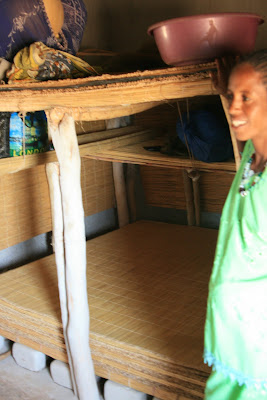
One woman invited me into her home to "see how the Peulhs live." Her bed here looked really comfortable actually.


 There are usually houses in the background
 Hazy view of my CSPS
 A layer of dust on everything, even my awesome blue plastic patio chair
 The chauve-souris, in the flesh
 About to strike
 On the first day, the women whip a product called tansagex in a large basin for 10 minutes. The tansagex is sold by the kilo in the capital. It is basically concentrated soap that resembles shaving cream or marshmallow fluff after a good beating.


 Finally, the arrival of M. le President

 Eventually, it is our turn. Don't we look sharp?
 What is a parade without baton-twirling, pompom-waving cheerleaders? N.B. this was the first time I had even seen cheerleaders in this country.
 Burkinabe veterans marching
 Bringing out the heavy artillary
 Even heavier
 An impressive sight: 6 men on one motorcycle


